Armor Door
A biometric security door may look fully electronic, but its outage response depends on stored credentials, backup power, and mechanical safety design. The practical question is: “How do biometric security doors work during a power outage?” Most systems use a battery backup, an uninterruptible power supply, or a building emergency circuit. These components keep the scanner, controller, and lock operating for a limited period. When power disappears, the door may still recognize an authorized fingerprint or face. However, the backup battery cannot last indefinitely.
The U.S. Energy Information Administration reported that American electricity customers experienced about 5.6 hours of interruptions in 2022, including major events. That figure shows why outage planning matters beyond the showroom demonstration. NIST Special Publication 800-63B also warns that biometrics should not act as a standalone secret. A reliable door therefore combines biometric matching with local templates, access rules, and a secondary credential. The controller should continue working even when the network is unavailable. A small status light may change from green to amber, while an audible alarm signals low battery power. Simple details matter.
Safety remains central. UL 294 and life-safety guidance require access-control equipment to support defined emergency behavior, but the correct response depends on the building and door type. Some doors remain locked to protect restricted areas. Others release during fire alarms or evacuation conditions. No design is flawless. Batteries age, sensors fail, and poorly tested backup systems can create dangerous assumptions. This article examines the hardware, fail-safe choices, battery limits, and testing practices that determine how biometric security doors behave when the lights go out.
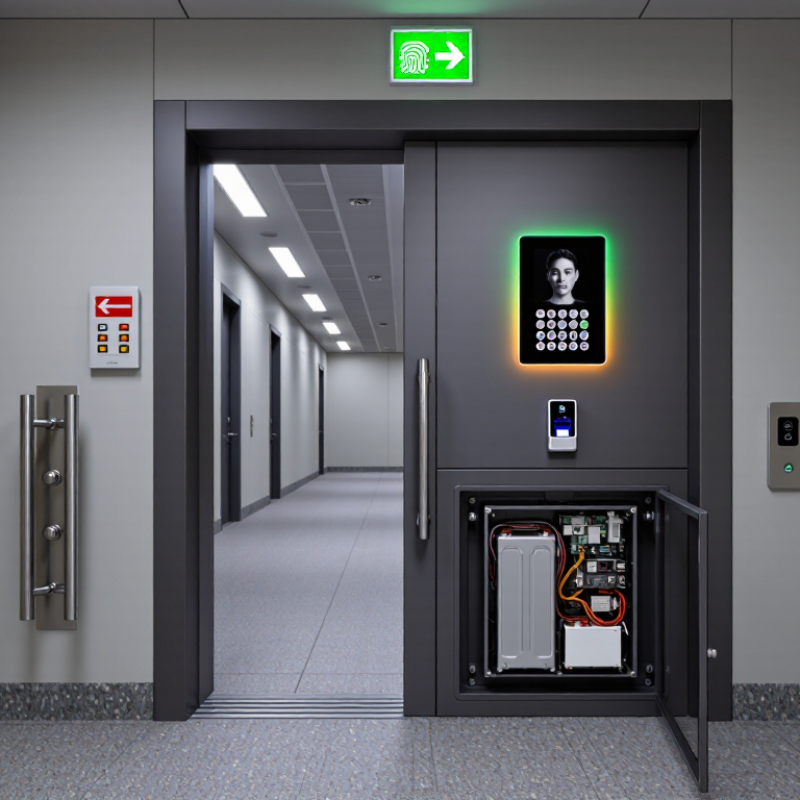
Power-failure detection is central to biometric door performance during an outage. The access controller monitors its power path, backup supply, and related fault signals. When voltage drops, it may record an event, send an alarm, or transfer control to a standby battery. The door’s response depends on its safety design and local life-safety requirements. Some doors remain locked to protect restricted areas. Others release to support emergency exit. A biometric reader cannot make that decision alone.
UL 294 testing examines access-control equipment under defined electrical and operating conditions. It can assess power interruption, restoration, abnormal voltage, battery operation, and communication with connected components. The exact test scope depends on the equipment category and installation. During a professional inspection, technicians should check detection time, alarm reporting, relay behavior, and event logs. They should also test the wiring between the controller, lock, sensor, and emergency release device. Small wiring faults matter. They may remain invisible during normal operation.
Tips: Test the door with primary power removed, then restore it. Confirm that the reader, lock, alarm, and exit hardware behave as documented. Check battery age and charging status. Keep records of every result. No test plan is perfect. Conditions in a real outage may differ, especially when batteries are cold, aged, or poorly maintained. Review the site’s emergency procedures regularly.
Biometric security doors use a fingerprint, facial, or vein reader to verify an authorized person. During a power outage, the reader and control panel switch to backup power. The lock then follows its programmed fail-safe or fail-secure setting. Emergency release devices should remain available, while access records may continue storing locally.
Backup power sizing requires a practical calculation:
The 0.8 factor allows for conversion losses, battery aging, temperature changes, and a safety margin. For example, a 240 Wh battery supporting a 30-watt system provides about 6.4 hours, not eight hours. That estimate includes the reader, controller, lock, warning lights, and network equipment if they share the battery. Measure real consumption rather than trusting a label. Small differences matter.
In field checks, I would test the door with the battery partly discharged. A system that works perfectly on a new battery may behave differently after months of standby. Cold rooms can reduce available capacity. Frequent authentication attempts can also increase demand. Keep a written load list, inspect terminals, and replace batteries according to measured performance, not guesswork. The formula is useful, but it is not a promise. A door may still unlock while its reader, camera, or communication module shuts down early. Planning for the weakest component is often safer.
How Do Biometric Security Doors Work During a Power Outage?
A biometric security door depends on more than its fingerprint or facial reader. During an outage, the access controller, lock, alarm interface, and emergency power supply must work as one system. The NFPA 72 benchmark commonly used for fire alarm power supplies is 24 hours of standby operation, followed by 5 minutes of alarm operation. This reserve supports monitoring before an alarm and signaling during an emergency.
The requirement is not automatically identical for every biometric door. Local codes, system design, and the authority having jurisdiction can change the details. A compliant installation may keep the reader and controller powered during standby. During an alarm, it should support required notification and the approved door-release strategy. Emergency egress must remain practical, even if the screen is dark. The hallway should not become a dead end.
A field test should simulate lost utility power, not just unplug the reader. Check the battery cabinet, controller, lock behavior, alarm relay, exit sensor, and trouble signal. Record the time until low-battery warnings appear. A label saying “24 hours” is not proof. Battery age, temperature, wiring losses, and added devices can reduce real capacity. That is the uncomfortable part. Some systems meet the calculation but fail under maintenance neglect. Qualified technicians should review battery sizing, inspect connections, and test the complete sequence under local requirements.
During a power outage, a biometric door does not simply “stop.” Its controller may switch to battery power, preserve event logs, or deny new scans. The critical question is what happens to egress. “Fail-safe” hardware unlocks when power is removed. “Fail-secure” hardware remains locked from the secure side. Yet occupants must still exit without keys, credentials, or special knowledge.
NFPA 101, Life Safety Code, governs this decision by occupancy and door type. It generally requires egress doors to be readily openable from the egress side. Some electrified locking arrangements must release during power loss, fire alarm activation, sprinkler operation, or manual emergency release, depending on the approved system. Other arrangements can remain secure externally while providing mechanical free egress internally. That distinction matters. A fingerprint reader can fail, while a panic bar still works. Designers should verify the exact clause with the authority having jurisdiction, rather than trust a generic “fail-safe” label.
NFPA’s Fire Loss in the United States During 2023 reports 1,504,500 fires and 3,670 civilian fire deaths. These figures support disciplined testing, although they cannot predict every outage. A practical commissioning test cuts utility power, triggers the fire interface, and checks both sides of the door. Technicians should record battery duration, latch release time, alarm response, and manual override performance. Small gaps remain. A door may pass a showroom demonstration yet fail after a depleted battery or miswired relay. That uncomfortable possibility deserves scheduled retesting and clear inspection records.
| Operating Condition | Typical Lock Response | Effect on Egress | NFPA 101–Related Consideration | Design Verification Point |
|---|---|---|---|---|
| Normal utility power | The biometric reader validates an authorized user and signals the electric lock or exit-control device to release. | Authorized entry may be controlled while occupants must still have a compliant path to exit. | Egress doors generally must be readily openable from the egress side without a key, special knowledge, or excessive force, subject to occupancy-specific provisions. | Confirm door hardware, access-control settings, delayed-egress features, and occupant load against the adopted code edition. |
| Short utility interruption with battery backup | The reader, controller, and lock may continue operating from a listed standby power supply or battery system. | Normal credentialed access may continue temporarily, but the exit function must remain available even if the access-control system stops responding. | Standby power does not replace the requirement for compliant egress. Emergency power and exit access are separate design issues. | Determine the rated duration, supervision, recharge time, and failure indication of the backup power system. |
| Complete loss of power to a fail-safe lock | The locking mechanism typically releases when electrical power is removed. | Egress is generally maintained during a power failure, although controlled entry may also be lost. | This arrangement can support life-safety egress where the hardware and installation comply with the applicable door, fire-protection, and access-control provisions. | Verify that releasing the lock does not compromise required fire-resistance, smoke-control, security, or compartmentation features. |
| Complete loss of power to a fail-secure lock | The outside trim typically remains locked, while the inside lever, panic hardware, or other approved egress hardware remains usable. | Entry may be restricted, but occupants must not be trapped on the egress side. | Fail-secure behavior is acceptable only when the door can still be opened from the egress side as required by the occupancy and door configuration. | Test the door with the reader offline, controller unpowered, and all credential-dependent functions unavailable. |
| Fire alarm or other emergency release signal | Where required, the access-control system releases designated doors through a listed interface or power-disconnect arrangement. | Occupants can exit without biometric authentication when the emergency release sequence is activated. | The adopted NFPA 101 provisions and related fire-alarm requirements determine when automatic release is required for a particular locking arrangement. | Confirm signal priority, release timing, reset procedure, monitoring, and coordination with the fire-alarm system. |
| Power failure combined with a failed battery | The biometric reader and electronic decision-making may become unavailable; the mechanical egress hardware should remain functional. | Exit must not depend on fingerprints, facial recognition, a PIN, network communication, or electrical power. | Egress hardware must provide the required level of reliability and immediate usability for the occupancy type. | Perform a worst-case test using depleted backup power and verify that mechanical release is intuitive and unobstructed. |
| Door serving a fire-rated or smoke-barrier opening | The biometric access function may control entry, but the complete door assembly must continue to perform its fire and smoke-control role. | Egress, self-closing, latching, and emergency-release functions must work together without defeating the rated opening. | Door, frame, closer, lock, glazing, and access-control components must be compatible with the required listed assembly and the adopted code. | Check listing compatibility, fire-door inspection requirements, latch retraction, and release behavior during both alarm and power-loss conditions. |
| Routine inspection and testing | The complete system is tested under normal power, backup power, power loss, emergency release, and communications failure. | Reliable egress is demonstrated instead of assumed from the biometric reader’s normal operation. | NFPA 101 compliance depends on the installed arrangement, occupancy, local amendments, and authority having jurisdiction approval. | Document test results, corrective actions, inspection dates, and approval by the authority having jurisdiction. |
During a power outage, a biometric security door should not simply stop. Its controller switches to backup power, preserves approved credentials, and applies a configured safe or secure state. Fingerprint or facial templates may remain cached locally, while battery alarms record the failure time. The real test begins when power returns.
IEC 60839-11-1 offers a practical framework for restoring access systems and reviewing event history. Operators should verify controller identity, clock accuracy, firmware status, and stored transactions before reopening normal access. Each event needs a clear timestamp, user reference, access result, and restoration marker. A missing timestamp can weaken an investigation.
Keep logs protected and exportable. The 2024 Data Breach Investigations Report found that human involvement appeared in 68% of breaches. That finding matters here: rushed recovery can create unnoticed gaps. The 2024 Cost of a Data Breach Report placed the average global breach cost at 4.88 million US dollars. Strong audit trails cannot prevent every failure, but they reduce uncertainty. One weakness remains. Many facilities test backup batteries, yet rarely rehearse log recovery after a full shutdown. That assumption is risky. Technicians should simulate power loss, inspect duplicate events, confirm emergency release behavior, and compare local records with the central monitoring system. Recovery is not complete until the door, controller, and audit trail agree.
This illustrative recovery profile shows how an access-control system may progress after mains power is restored. Power-loss, battery-mode, restoration, log-integrity, and synchronization events should be recorded in the audit trail. IEC 60839-11-1 provides requirements for access-control system operation and event recording, but it does not prescribe one fixed recovery time for every installation. Actual timing depends on the controller, backup power, network, and configuration.
A common fire-alarm benchmark uses 24 hours of standby power and five minutes of alarm operation. The exact requirement depends on local codes and the approved system. A “24-hour” label proves little by itself.
The controller may switch to battery power and continue checking approved credentials. It might also deny new scans while preserving event logs. The screen can go dark. Exit must still work.
The correct behavior depends on occupancy, door type, and local approval. Some doors unlock when power is removed. Others remain secure externally but allow free mechanical exit inside. Labels alone are not enough.
Yes, emergency egress should remain possible without special knowledge or credentials. A panic bar or mechanical release may provide exit access. Test it from the occupied side. Never assume.
Cut utility power and check the battery cabinet, controller, lock, alarm relay, and exit sensor. Trigger the fire interface if the system uses one. Record release time, battery warnings, and alarm response. Unplugging only the reader is inadequate.
Battery age, cold or heat, wiring losses, and extra devices reduce real capacity. Loose connections can also weaken performance. A calculated result may look perfect on paper. Reality is less tidy.
Confirm the controller identity, clock accuracy, firmware status, and stored transactions. Check that every event has a timestamp, user reference, and access result. Compare local records with central monitoring records. Missing timestamps create doubt.
Retest after maintenance, battery replacement, wiring changes, and extended shutdowns. Routine checks should include emergency release and log recovery. Many facilities test batteries but ignore restored event history. That is a weakness.
How do biometric security doors work during a power outage? They rely on layered power planning and carefully defined lock behavior. The access-control system first detects a power failure and evaluates its power paths according to UL 294 testing principles. Backup batteries are then sized using the formula: runtime = battery watt-hours × 0.8 ÷ system watts, allowing designers to estimate how long biometric readers, controllers, and locks can continue operating. A practical benchmark from NFPA 72 is 24 hours of standby capacity followed by a five-minute alarm reserve.
During an outage, the door may operate in fail-safe or fail-secure mode, depending on the building’s egress requirements under NFPA 101. Emergency exit routes must remain usable, while restricted areas may retain controlled access when appropriate. Once normal power returns, the system should restore devices in a controlled sequence, verify biometric functions, and preserve access events and power-related alerts. IEC 60839-11-1 provides guidance for recovery procedures and audit logs, supporting accountability and reliable system restoration.
